> For the complete documentation index, see [llms.txt](https://docs.appmixer.com/llms.txt). Markdown versions of documentation pages are available by appending `.md` to page URLs; this page is available as [Markdown](https://docs.appmixer.com/connector-configuration/microsoft-dynamics-365-crm.md).
# Microsoft Dynamics 365 CRM
Register an OAuth2 application in a similar way as usual [Microsoft Azure App](https://docs.appmixer.com/connector-configuration/microsoft.md) with few changes:
* you don't need to configure OneDrive file picker
* configure API permissions for Dynamics 365, see below
## OAuth app properties
| Property | Value |
| ----------------------- | ------------------------------------------------------------------------------------------------------------------------------------------------------------------------------------------------------------------------------------------------------------------------------------------------------------------------------ |
| **Multi-tenant** | **Yes.** With a multitenant app registration, users of any Microsoft Entra tenant can connect. Each user needs access to a Dataverse environment in their own tenant. |
| **Vendor review** | **By scope.** No review of the app. Users can consent to the Dynamics CRM delegated permission themselves unless their tenant restricts user consent; then a tenant admin grants it. Publisher verification is optional; see [Microsoft](https://docs.appmixer.com/connector-configuration/microsoft.md#oauth-app-properties). |
| **Review time** | Not applicable. Admin consent, when needed, depends on each customer's admin. |
| **Users before review** | No limit. |
| **App owner** | Any Microsoft Entra tenant. |
| **Regions** | One app for all Dataverse regions of the global Microsoft cloud. The user enters their environment URL (for example `https://org.crm4.dynamics.com`). |
| **Client secret** | Expires after at most 24 months; Microsoft recommends less than 12. |
| **Rate limits** | Per user and web server of the environment: 6,000 requests and 20 minutes of execution time in a 5-minute sliding window, 52 concurrent requests. Daily request entitlements depend on the customer's licenses. |
| **Checked** | 2026-11-13 |
**Limitations**
* The connecting user must be a user of the Dataverse environment with a security role that allows the operations. Lead components also need the Sales app in the environment.
* When the client secret expires, every connected account fails until you set a new secret in the Backoffice.
* A refresh token that is not used for 90 days expires. The user then connects the account again.
* The connector signs in through the `common` endpoint; the custom tenant option of the Microsoft connectors does not apply here.
Sources: [OAuth with Dataverse](https://learn.microsoft.com/en-us/power-apps/developer/data-platform/authenticate-oauth), [Service protection API limits](https://learn.microsoft.com/en-us/power-apps/developer/data-platform/api-limits), [App consent policies](https://learn.microsoft.com/en-us/entra/identity/enterprise-apps/manage-app-consent-policies), [App credentials](https://learn.microsoft.com/en-us/entra/identity-platform/how-to-add-credentials), [Refresh tokens](https://learn.microsoft.com/en-us/entra/identity-platform/refresh-tokens). What the rows mean: [OAuth app properties](https://docs.appmixer.com/connector-configuration/oauth-app-properties.md).
## Register the app
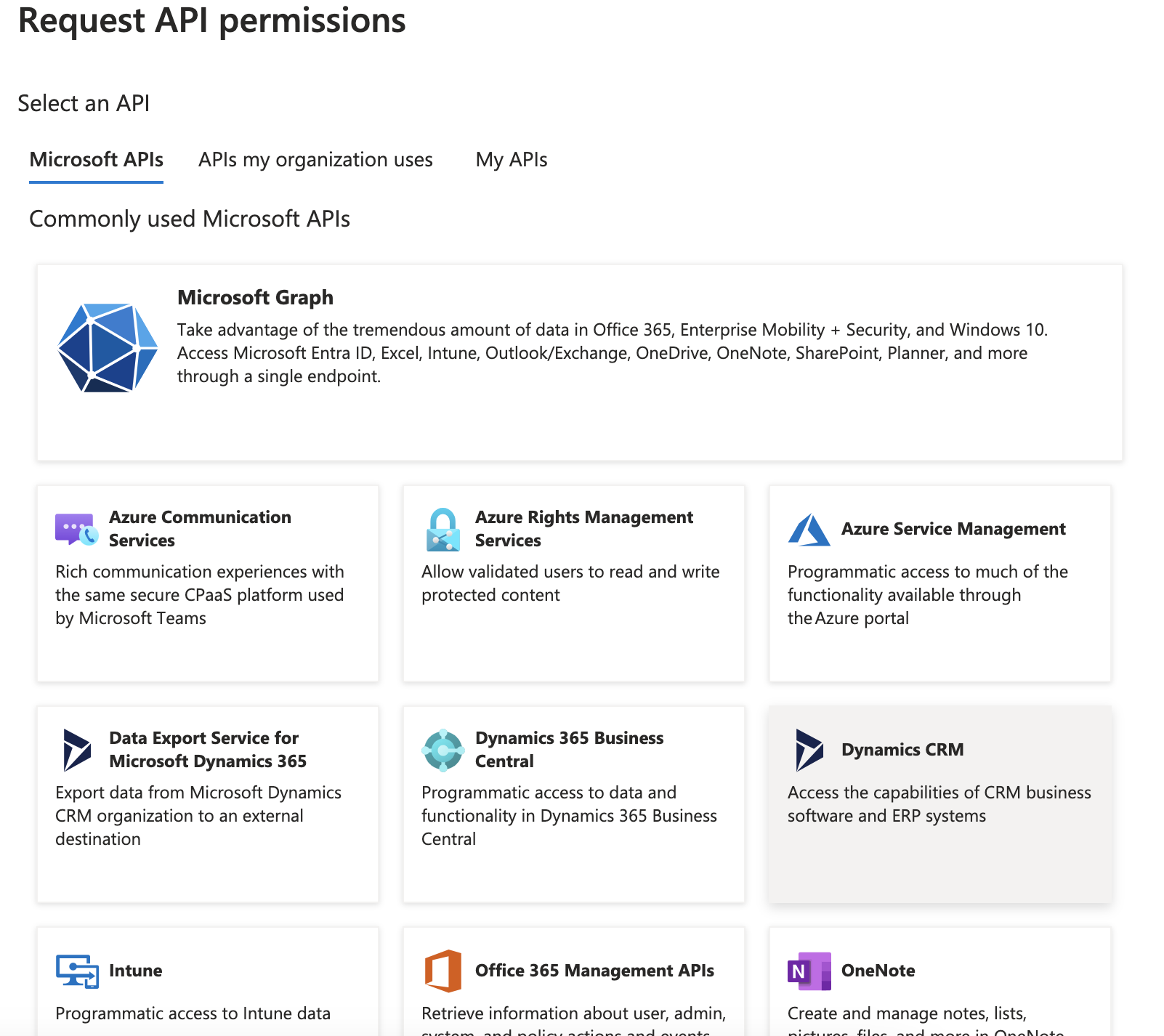
Go to the *API permissions* section:

Choose *Dynamics CRM*:
Delegated permissions:

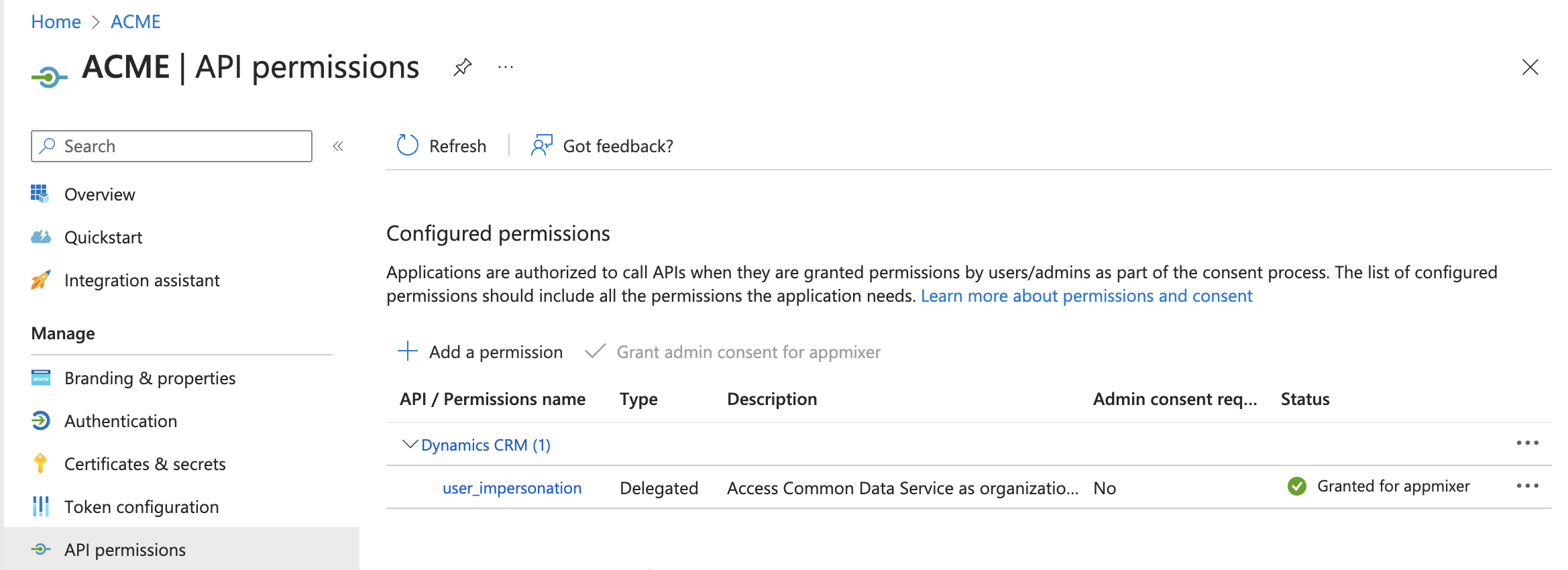
The final set of permissions:
**Creating CRM Dataverse environment**
In order to use the Microsoft Dynamics 365 CRM connector, you'll need a Dataverse environment alongside your Microsoft account. You can review your environments in [PowerPlatform administration](https://admin.powerplatform.microsoft.com/environments). If you don't have any environment there, you can start with a [trial](https://dynamics.microsoft.com/en-us/dynamics-365-free-trial/). From the list of available apps, select Dynamics 365 Sales. Once you complete the sign-up process, the CRM environment will be created.
Once created you can view details of the environment and see Environment URL address which you will need when connecting a Microsoft Dynamics 365 CRM component to your account.
Note that in order to interact with Lead entities, you'll need to install Sales module into your Dataverse environment. Some entities like Contact or Account come with a Dataverse environment by default, but it is not the case for Lead entity.
## Backoffice configuration
Configuration ID: `appmixer:microsoft:dynamics` (Backoffice → Configuration; see [Connector Configuration](https://docs.appmixer.com/getting-started/services) for how a configuration is created and how its keys reach the connector). It is separate from the `appmixer:microsoft` configuration of the other Microsoft connectors, even when both use the same Azure app.
* `clientId` — the *Application (client) ID* of the Azure app registered above. Not needed when Microsoft Dynamics 365 CRM is authenticated through the Appmixer Auth Hub.
* `clientSecret` — the *Value* of the app's client secret. It expires (at most 24 months); update it before then. Not needed with the Auth Hub.
* `listLookupOptionsCacheTTL` — Optional. How long, in milliseconds, the values of Lookup fields (for example Currency or Contact) offered in the inspector select boxes are cached. Default `60000` (1 minute).
* `listInspectorCacheTTL` — Optional. How long, in milliseconds, the structure of the Dataverse environment used for the inspector is cached. After you add or change a table (for example a column type), the inspector shows the change once this time has passed. Default `3600000` (1 hour).
* `listOutportCacheTTL` — Optional. The same for the output port schema of the components. Default `3600000` (1 hour).
* `outputFilePrefix` — Optional. File name prefix of the CSV file that **List Accounts**, **List Contacts**, **List Entities** and **List Leads** create when their output is set to a file; the file is named `-.csv`. Default `microsoft-export`.
The same keys can be set with the CLI (`-u` updates the existing configuration instead of creating it):
```bash
appmixer service-config set appmixer:microsoft:dynamics -u -d '{
"clientId": "",
"clientSecret": ""
}'
```
---
# Agent Instructions
This documentation is published with GitBook. GitBook is the documentation platform designed so that both humans and AI agents can read, navigate, and reason over technical content effectively. Learn more at gitbook.com.
## Querying This Documentation
If you need additional information that is not directly available in this page, you can query the documentation by asking a question.
Perform an HTTP GET request on the following URL with the `ask` and `goal` query parameters:
```
GET https://docs.appmixer.com/connector-configuration/microsoft-dynamics-365-crm.md?ask=&goal=
```
`ask` is the immediate question: it should be specific, self-contained, and written in natural language.
`goal` is what the user is ultimately trying to achieve, the reason they need the answer. Sharing it helps GitBook give you a better, more relevant answer. A goal is most helpful when it describes the outcome the user wants rather than restating the question. For example, with `ask=how do I create an API token`, a goal like `automate deployments from our CI pipeline` lets GitBook tailor the answer to that use case.
The response will contain a direct answer to the question and relevant excerpts and sources from the documentation.
Use this mechanism when the answer is not explicitly present in the current page, you need clarification or additional context, or you want to retrieve related documentation sections.