> For the complete documentation index, see [llms.txt](https://docs.appmixer.com/llms.txt). Markdown versions of documentation pages are available by appending `.md` to page URLs; this page is available as [Markdown](https://docs.appmixer.com/customizing-embedded-ui/custom-theme.md).
# Custom Theme
Customize UI widgets. You can change the colors, the typography, and much more.
## Basic usage
To customize the UI widgets, you need to specify a `theme` JSON object either in the Appmixer constructor:
```javascript
const appmixer = new Appmixer({
theme: {
variables: {
font: {
family: "sans-serif"
},
colors: {
neutral: "orange"
}
}
}
});
```
and/or use the option with individual widgets:
```javascript
const flowManager = appmixer.ui.FlowManager({
el: "#my-flow-manager",
theme: {
variables: {
colors: {
neutral: "purple"
}
}
}
});
```
## Usage with multiple themes
If you wish to switch between themes, use the `set("theme")` method, this will automatically re-render the UI applying your new theme:
```javascript
// change the theme of all widgets
appmixer.set('theme', {
variables: {
font: {
family: 'serif'
}
}
})
// or/and change the theme of a single widget
widget.set('theme', {
variables: {
colors: {
neutral: 'green'
}
}
});
```
## Variables
The easiest way to change the overall styling is to use the theme `variables`. The following example shows a complete list of variables that you can set in your theme to match your product branding:
```javascript
appmixer.set('theme', {
mode: 'light', // Determines the color mode of the theme: 'light' or 'dark'.
variables: {
// Font variables including font family, weights, and size.
font: {
family: '\'SF Pro Text\', \'Helvetica Neue\', \'Helvetica\', \'Arial\', sans-serif',
familyMono: '\'SF Mono\', \'ui-monospace\', Menlo, monospace',
weightRegular: 400,
weightMedium: 500,
weightSemibold: 600,
weightBold: 700, // Added key for bold font weight.
size: 14
},
// Color variables for various UI elements, with light and dark mode defaults.
colors: {
background: '#FFFFFF', // Color of the background. The areas accomodate surfaces.
surface: '#FFFFFF', // Color of the surfaces above background and other surfaces.
separator: '#E0E0E2', // Separator is a special color for various borders and lines.
neutral: '#1F2338',
primary: '#2A64F6', // Colors for primary, secondary and tertiary actions of the user.
secondary: '#6B7EB3',
tertiary: '#8C6C87',
error: '#B3261E',
warning: '#B56C09',
success: '#08B685',
modifier: '#C558CF', // Special color for variables that have been modified via Modifiers.
highlighter: '#FFA500'
},
// Shadow variables for different elevation levels and UI elements.
shadows: {
level0: '0 0 4px 0 rgba(60, 64, 67, 0.3)', // Shadows from level 0 to 5 serve to assist with elevation levels between surfaces.
level1: '0 0 1px rgb(125 125 126)',
level2: '0 1px 2px 0 rgba(60, 64, 67, 0.3), 0 1px 3px 1px rgba(60, 64, 67, 0.12)',
level3: '0 2px 4px 0 rgba(60, 64, 67, 0.3), 0 2px 6px 1px rgba(60, 64, 67, 0.12)',
level4: '0 3px 9px 0 rgba(60, 64, 67, 0.15), 0 3px 12px 1px rgba(60, 64, 67, 0.12)',
level5: '0 4px 8px 0 rgba(60, 64, 67, 0.3), 0 4px 12px 1px rgba(60, 64, 67, 0.12)',
backdrop: 'rgba(0 0 0 / 88%)', // Backdrop is a special shadow to cover the background of modals and popups.
blur: 'rgba(0 0 0 / 10%)', // Blur is an alternative for "backdrop" when the background is blurred instead.
popover: '0 3px 9px rgba(0 0 0 / 12%)', // Popover is a special shadow for popups that should be at the maximum elevation.
icon: '0 1px 3px rgb(0 0 0 / 6%)'
},
// Radius variables for element and container corners.
corners: {
elementRadiusSmall: '3px',
elementRadiusMedium: '6px',
elementRadiusLarge: '9px',
elementRadiusRound: '300px',
containerRadiusSmall: '3px',
containerRadiusMedium: '6px',
containerRadiusLarge: '9px'
},
// Border width variables for UI elements.
dividers: {
regular: '1px', // Width of border lines and separator lines in the UI.
medium: '2px',
semibold: '3px',
bold: '6px',
extrabold: '9px'
}
}
})
```
## Shapes
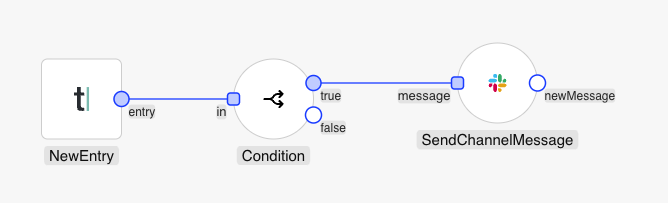
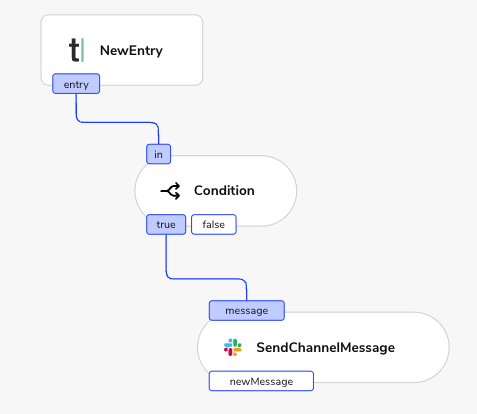
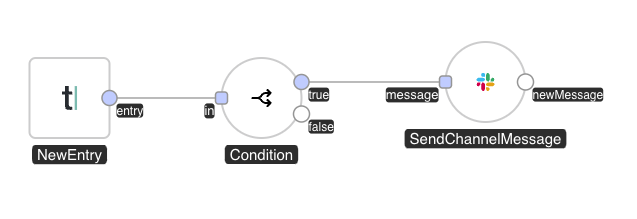
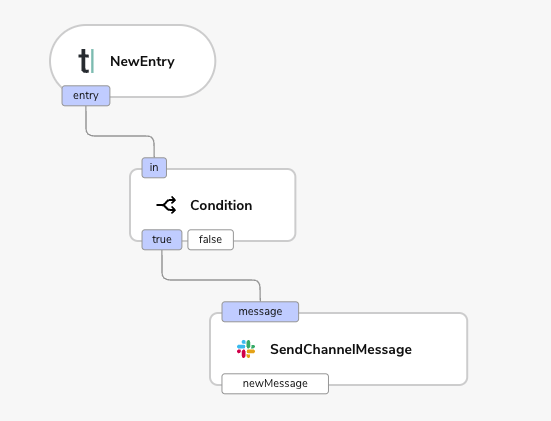
Shapes of connectors in diagrams are customizable by choosing a preset in your theme.
```javascript
appmixer.set('theme', {
ui: {
shapes: {
action: "action",
trigger: "trigger",
selection: "selection"
}
}
})
```
Change the values of the entries to switch between presets. Here are built-ins per shape type:
{% hint style="info" %}
The `-vertical` presets select the top-to-bottom layout, which keeps the Designer on the previous diagram — the new diagram supports left-to-right layouts only. See [Designer → Diagram](/appmixer-ui-sdk/ui-and-widgets/designer.md#diagram).
{% endhint %}
action
action-vertical
action-dark
action-vertical-dark
trigger
trigger-vertical
trigger-dark
trigger-vertical-dark
selection
selection-vertical
selection-dark
selection-vertical-dark
### action/trigger
### action-vertical/trigger-vertical
### action-dark/trigger-dark
Special version of actions and triggers that works better on dark backgrounds.
### action-vertical-dark/trigger-vertical-dark
Special version of vertical actions and triggers that works better on dark backgrounds.
## Advanced UI Styling
The theme JSON object references the entire Appmixer SDK UI in a complex tree of selectors. Elements use a hash symbol (`#`) prefix and dynamic states use the at sign (`@`). Each branch in the tree may hold nested selectors and any valid CSS properties for the element. The selectors are available for advanced customizations, but the structure may change between the Appmixer versions.
```javascript
appmixer.ui.FlowManager({
el: '#app',
theme: {
ui: {
'#FlowManager': {
background: 'lightblue',
'#header': {
padding: '0 0 24px 0',
'#buttonCreateFlow': {
color: 'yellow',
'@hovered': {
color: 'white'
}
}
}
}
}
}
});
```
{% hint style="info" %}
While the advanced theme styling gives you the most flexibility in customizing Appmixer UIs, we cannot guarantee that in some cases, the structure and nesting of the selectors might change between Appmixer versions. It is therefore recommended to use [`theme.variables`](#variables) instead.
{% endhint %}
#### Colors
The numbers in the names of colors refer to a foreground opacity of the color over the base background color:
* `neutral96` is a foreground color with 96% opacity over the background `neutral00`.
* Some colors need a negative color `NG` on top. For example, a white text on a blue button.
#### Font
The numbers in size of the font refer to the defaults in pixels: `size13` variable default is 13px.
## Scrollbars
Appmixer widgets render thin, theme-coloured scrollbars instead of the browser's native ones. The difference is most visible on Windows, where native scrollbars are wide and grey. The thumb colour comes from the theme's `scrollbarColor` property and defaults to `neutral32` over a transparent track — it is derived from the palette, so a custom theme adapts automatically.
Because `scrollbar-color` is an inherited CSS property, it is set on the root that anchors each part of the UI. There are **three** such roots, and a theme that overrides only some of them leaves the rest unthemed:
| Theme path | Applies to |
| ------------------------------------------ | ----------------------------------------------------------------------------------------------------------------------------------------- |
| `ui.mixins['#container'].scrollbarColor` | Scrollable areas inside a normal widget. |
| `ui.mixins['#widgetModal'].scrollbarColor` | Widgets rendered inside a modal, which have no `#container` ancestor. |
| `ui['#scrollbars'].scrollbarColor` | Overlays teleported to `document.body` — modals, popovers, the Automation Hub dialog, the flow logs popover and the field editor overlay. |
The third one is a **top-level scope, not a mixin**: teleported overlays render outside the widget subtree, so neither mixin can reach them.
```javascript
appmixer.set('theme', {
ui: {
'#scrollbars': {
scrollbarColor: 'rgba(0, 0, 0, 0.4) transparent'
},
mixins: {
'#container': {
scrollbarColor: 'rgba(0, 0, 0, 0.4) transparent'
},
'#widgetModal': {
scrollbarColor: 'rgba(0, 0, 0, 0.4) transparent'
}
}
}
});
```
The colour can also be set per widget, for example under `'#Designer'`. Setting `scrollbarColor: 'auto'` restores the browser's native thumb colour, and the native width can be restored from the host page:
```css
.am-widget * { scrollbar-width: auto; }
```
{% hint style="warning" %}
If your host application styles `::-webkit-scrollbar` inside Appmixer widgets, **those rules no longer apply in Chromium**. Setting the standard `scrollbar-width` / `scrollbar-color` properties switches Chrome and Edge to the standard scrollbar rendering path, where the `::-webkit-scrollbar` pseudo-elements are ignored. Migrate such styling to the standard properties, or neutralise the SDK defaults as shown above. Safari before 18.2 still renders native scrollbars.
{% endhint %}
## Complete Theme Object
For reference, we prepared a dark theme for all the Appmixer UI widgets that you can use as a quick overview of all the UI elements that you can set your custom theme for:
```bash
wget https://my.appmixer.com/appmixer/package/theme-light.json
wget https://my.appmixer.com/appmixer/package/theme-dark.json
```
Screenshots of the dark theme for some of the UI widgets:


---
# Agent Instructions
This documentation is published with GitBook. GitBook is the documentation platform designed so that both humans and AI agents can read, navigate, and reason over technical content effectively. Learn more at gitbook.com.
## Querying This Documentation
If you need additional information that is not directly available in this page, you can query the documentation by asking a question.
Perform an HTTP GET request on the following URL with the `ask` and `goal` query parameters:
```
GET https://docs.appmixer.com/customizing-embedded-ui/custom-theme.md?ask=&goal=
```
`ask` is the immediate question: it should be specific, self-contained, and written in natural language.
`goal` is what the user is ultimately trying to achieve, the reason they need the answer. Sharing it helps GitBook give you a better, more relevant answer. A goal is most helpful when it describes the outcome the user wants rather than restating the question. For example, with `ask=how do I create an API token`, a goal like `automate deployments from our CI pipeline` lets GitBook tailor the answer to that use case.
The response will contain a direct answer to the question and relevant excerpts and sources from the documentation.
Use this mechanism when the answer is not explicitly present in the current page, you need clarification or additional context, or you want to retrieve related documentation sections.